Anatomy of a High-Performance West Side Garage: Permitting, Power, and Craftsmanship
Summary: Building a high-end detached garage in Vancouver? Learn how Cloverleaf Builders navigates City permits, FSR rules, 200A upgrades, and...

Summary: Protect your Vancouver home from bad contractors. Learn 5 red flags to watch for and how to hire a trusted, Red Seal-level local builder.


A major home renovation is one of the largest financial and emotional investments of your life. In the expensive Vancouver real estate market, there is zero room for error. At Cloverleaf Builders, we occasionally get calls from panicked homeowners asking us to take over a project midway through. It is absolutely heartbreaking to walk onto a site and see that a previous contractor has done substandard work, cut critical corners, or bled a family’s life savings dry.
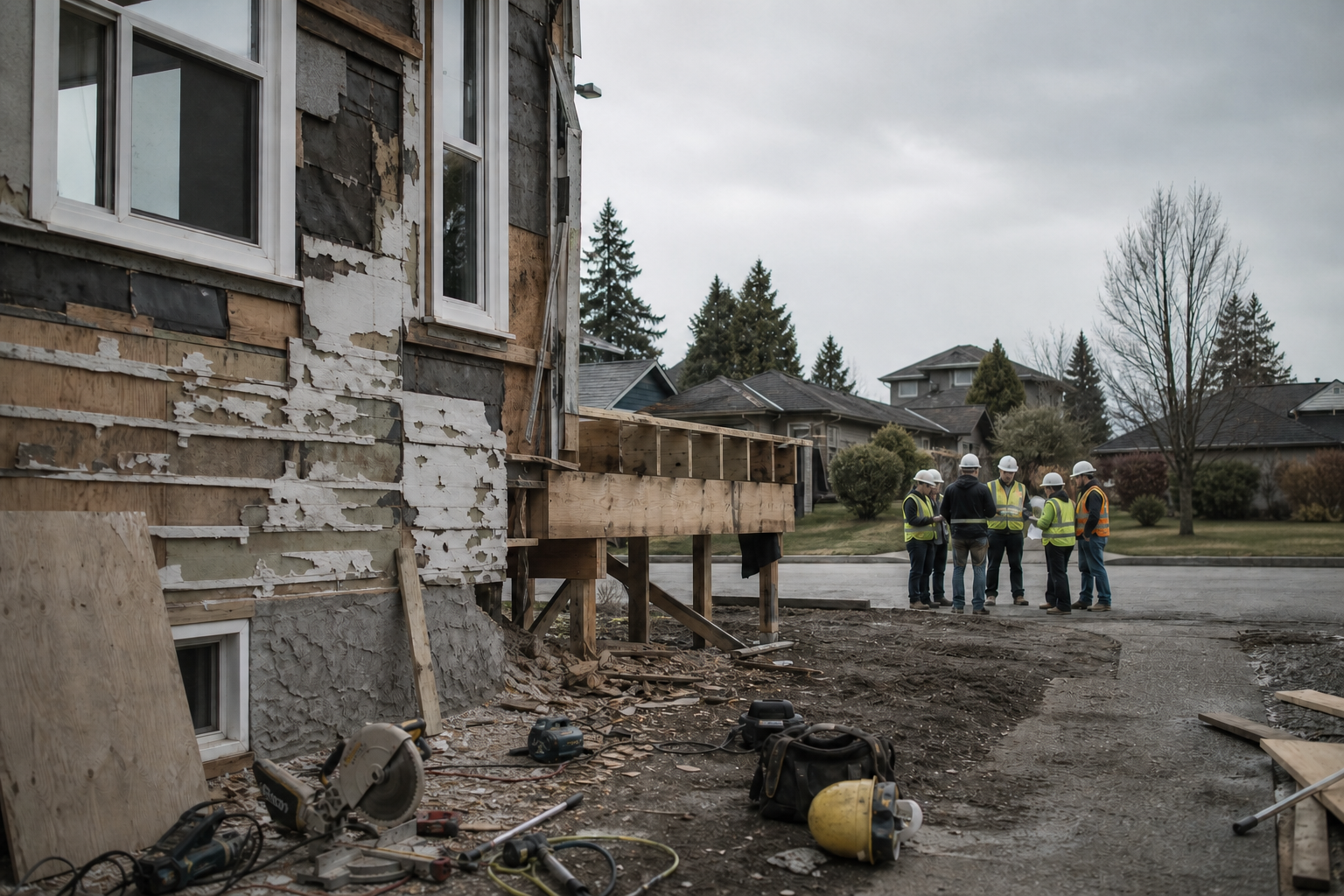
Recently, we stepped in to rescue a project where a contractor had been hired primarily to update a home's siding and roof. By the time the homeowners called us, the site was a disaster. The contractor had been shockingly lazy—rather than properly stripping the exterior, they left the old siding on and installed the new siding directly over top of it, which caused the walls to be crooked in a lot of places and reduced the walls ability to dry outward.
Worse, while the homeowners were away on vacation, the contractor took it upon themselves and started working on the structural components of their elevated deck without permission. Because they were billing hourly, they knew they could rack up the hours while the clients were out of town. This resulted in a stop-work order from the city, further delaying the project.
By the time we received instructions from the building inspector to complete the siding and roofing, tear out the shoddy siding, fixed the torch-on membrane on the upper deck, rebuild the parapet walls, and finished the job properly, it cost the homeowners an additional 25% above the contractors initial estimate. The most alarming part? This contractor was a referral.
How do you protect yourself before the first hammer swings? Here is our guide to spotting a bad contractor in the Lower Mainland before it is too late.
It is human nature to gravitate toward the lowest estimate. However, in construction, a lowball bid is often the most expensive choice you can make. Unscrupulous contractors will intentionally underbid just to win the job.
Once the contract is signed, you are suddenly hit with a barrage of "unforeseen" costs in the form of Change Orders. An experienced professional takes the time to thoroughly investigate your home, gather supplier and trade pricing, and anticipate potential unforeseen issues. If the scope of work is substantial, or complex to initially estimate, then a paid, detailed pre-construction process is needed. In older Vancouver homes, this means accounting for pre-1990 asbestos testing, proper rainscreen systems for our wet climate, and realistic BC Step Code energy upgrades.
If a builder provides an estimate without a detailed scope of work explaining how each part of the project will be executed, it indicates either a desire to keep details vague—allowing them to deliver less than expected—or a lack of experience in properly visualizing and planning the build.
Understanding how your contractor bills is critical to protecting your budget. As our rescue story illustrates, if a contractor is billing hourly on a loose Cost-Plus contract, there is zero incentive for them to work efficiently.
They might even invent projects—like building an unapproved deck—just to pad the bill. The project drags on, the hourly bills pile up, and you are left trapped in a bottomless money pit.
Which contract is right for your Vancouver renovation?
A contractor who suggests skipping the permitting process if needed, just to "save time and money" is putting all the legal and financial risk directly onto you. In Vancouver, making significant changes to your home, requires permits.
If you are caught, the city will issue a stop-work order. You may be forced to tear down the unpermitted work at your own expense, and pay double the permit fee costs. Safety Disclaimer: Never allow unpermitted structural, electrical, or plumbing work, or demolition in a pre-1990 home without proper hazmat abatement. It compromises your home's safety, voids your insurance, and puts your family at risk.
Furthermore, a General Contractor's primary job is management and supervision. If the contractor is never on-site and trades are left to work unsupervised, lazy mistakes—like ignoring membrane details or siding transitions—will inevitably be covered up. Ask prospective builders directly: Who will be managing the site day-to-day?
Before you hand over a deposit, ensure you are fully protected by a detailed Scope of Work attached to your quote and contract. If a contractor is vague on paper, they will be vague on your house.
The Scope of Work outlines the exact specifics of your individual project, detailing items such as specific finishes, timelines, and payment schedules.
Separately, a professional builder will provide a generic Construction Guide that applies to all projects as an overall roadmap. This document outlines general processes including how change orders are handled, site protection protocols, invoicing, and project closeout so there are no surprises during your build. For example, see The Cloverleaf Construction Guide.
As we learned from the siding and deck disaster, even a referral from a friend cannot always be trusted. A contractor might have done a great job building a simple cosmetic bathroom for your neighbor, but that doesn't mean they have the building knowledge to properly integrate a torch-on membrane deck with an exterior envelope.
Word-of-mouth is a starting point, not a finish line. Do your own homework. Look for patterns in their Google Reviews—are there mentions of disappearing acts or surprise bills?
Most importantly, ask to visit an active job site. An active site managed by a professional will be clean, organized, secure, and well-managed. If the site is a chaotic mess, your home will be treated the exact same way.
Your home is your sanctuary, and your hard-earned savings deserve to be treated with respect. It is always more expensive to pay someone to fix a broken project than it is to hire the right professional to do it perfectly the first time.
Renovating in Vancouver is stressful enough without having to micro-manage the people you hired to do the heavy lifting. Protect yourself by demanding transparency, proper contracts, and Red Seal-level quality from day one.
---
Ready to work with a team you can trust to guide you through a stress-free build? Contact Cloverleaf Builders today to book a Project Consultation. Let's discuss your dream project.
Insights and inspiration for Better Living Spaces