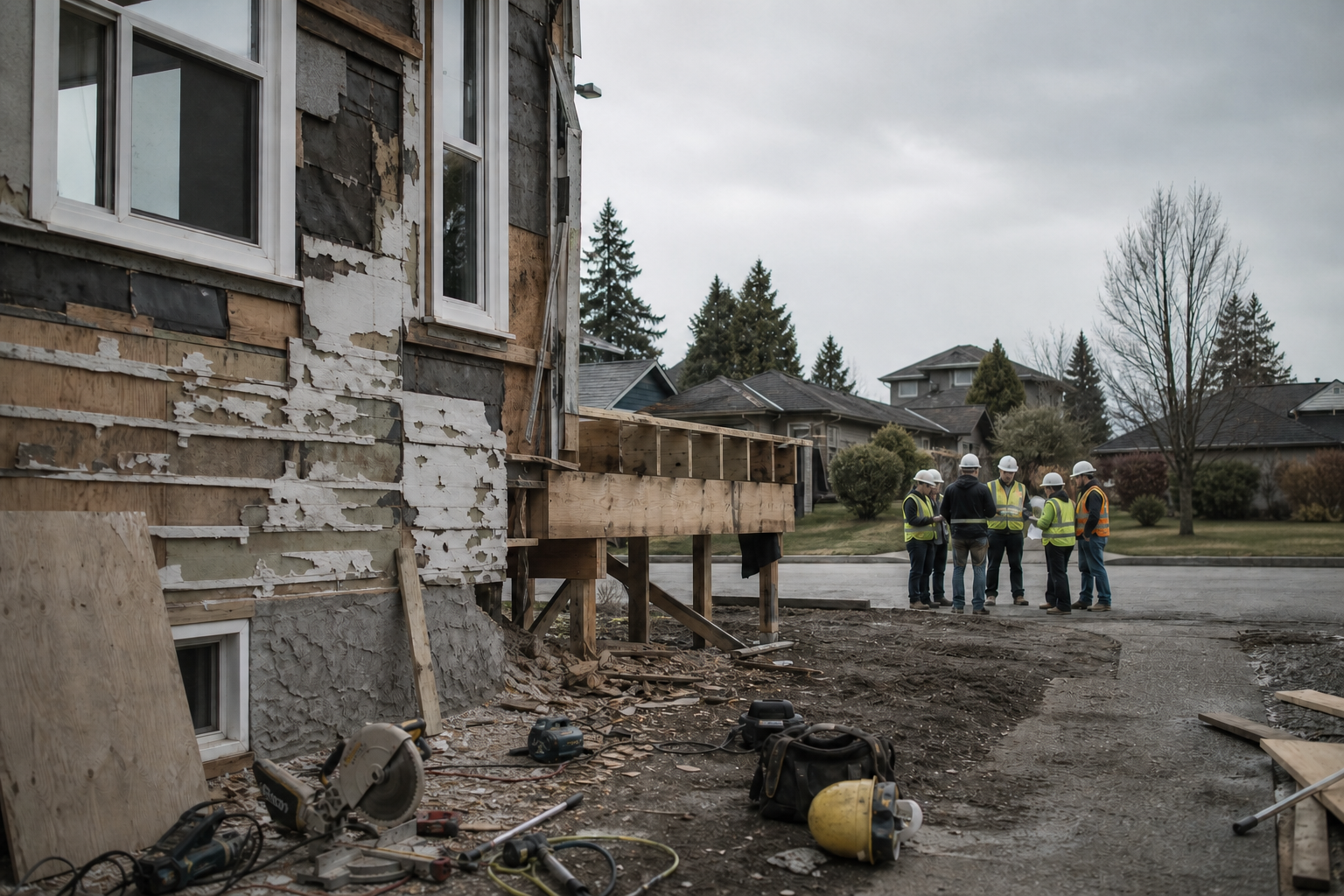
Learn The Red Flags That Could Cost You Your Savings
Summary: Protect your Vancouver home from bad contractors. Learn 5 red flags to watch for and how to hire a trusted, Red Seal-level local builder.
...

Summary: Discover why building science is just the blueprint, and how Cloverleaf Builders' meticulous home renovation craftsmanship provides the execution required to keep water out of your building envelope and create a highly resilient Vancouver home.

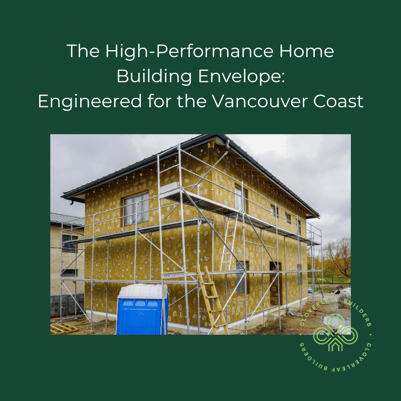
Right now, "building science" is the biggest buzzword in Vancouver construction. Custom builders talk endlessly about rainscreens, vapor drive, and thermal bridging. But understanding the theory is the easy part—anyone can read a manual, specify a high-end membrane, and do the bare minimum to pass a basic municipal envelope inspection.
Passing an inspection does not guarantee a home built to last generations. If science is the blueprint, craftsmanship is the critical execution that keeps water out. Too often, high-budget custom builds fail because execution was sloppy—lumber wasn't primed on all sides, flashing transitions were rushed, or the wrong sealants were used. At Cloverleaf Builders, we differentiate ourselves through relentless, meticulous craftsmanship. Every layer of your home's exterior must be flawlessly executed by hands that care.
A lasting envelope is rooted in architectural physics. Dr. Joe Lstiburek, a pioneering engineer at the Building Science Corporation whom I met in Seattle in 2018, defined the "Perfect Wall." His scientifically proven assembly relies on an absolute rule: the four principal control layers—water, air, vapor, and thermal—must be placed on the exterior of the structural framing. This exterior blanket completely protects the wood framing from temperature swings, condensation, and bulk water. But even the perfect wall on paper fails if the installers lack the discipline to execute the micro-details.
Our construction process is anchored by the "4 D’s" of building envelope management, a vital structural framework I first mastered at BCIT in 2019. These four protective principles sit in a strict, systemic order of importance:
As a certified Passive House Tradesperson, my building philosophy is deeply informed by the strict, physics-backed protocols of ultra-low energy construction: superinsulated envelopes, thermal-bridge-free construction, high-performance windows, balanced ventilation, and absolute airtightness. Applying this level of meticulous discipline to a structure dramatically transforms its durability and interior comfort.
While the minimum provincial baseline for Part 9 residential buildings is Step 3 (2.5 ACH), forward-thinking Metro Vancouver municipalities have adopted Step 4 (1.5 ACH) or Step 5 (1.0 ACH). We actively engineer and execute our envelopes to drop below 1.0 ACH (Air Changes per Hour), comfortably exceeding BC Net-Zero Ready milestones. This eliminates micro-gaps, preventing hidden interior air condensation inside wall cavities while cutting energy consumption.
Traditional house wraps (like standard Tyvek) are fastened with staples, creating thousands of tiny puncture holes. At Cloverleaf Builders, we recommend premium, self-adhered membranes like SIGA Majvest 500 SA and Soprema Sopraseal Stick VP. This requires a highly skilled application to ensure a continuous, airtight, and watertight seal that bonds directly to the sheathing without voids.
Every single utility line piercing the sheathing is a potential failure point. Our strict craftsmanship protocol mandates that we air-seal all penetrations at the sheathing layer using specialized rubber WRB gaskets and high-performance flashing tapes. We strictly enforce a disciplined "one hole for one cable" rule. Instead of sealing a cluster of multiple wires with a messy, unreliable blob of expanding foam, we drill separate, precisely sized holes for each independent line, sealing each copper line or cable with its own dedicated gasket integrated directly into the WRB drainage plane.
To achieve true high-performance weatherproofing, we highly advocate for exterior continuous insulation, frequently referred to as "outsulation."
Nominal R-value is simply the number stamped on a bag of insulation. However, wood studs conduct heat out of a building quickly (thermal bridging). When accounting for the structural lumber cutting through your insulation layer, your effective R-value drops drastically—sometimes from an R-22 down to an effective R-12.
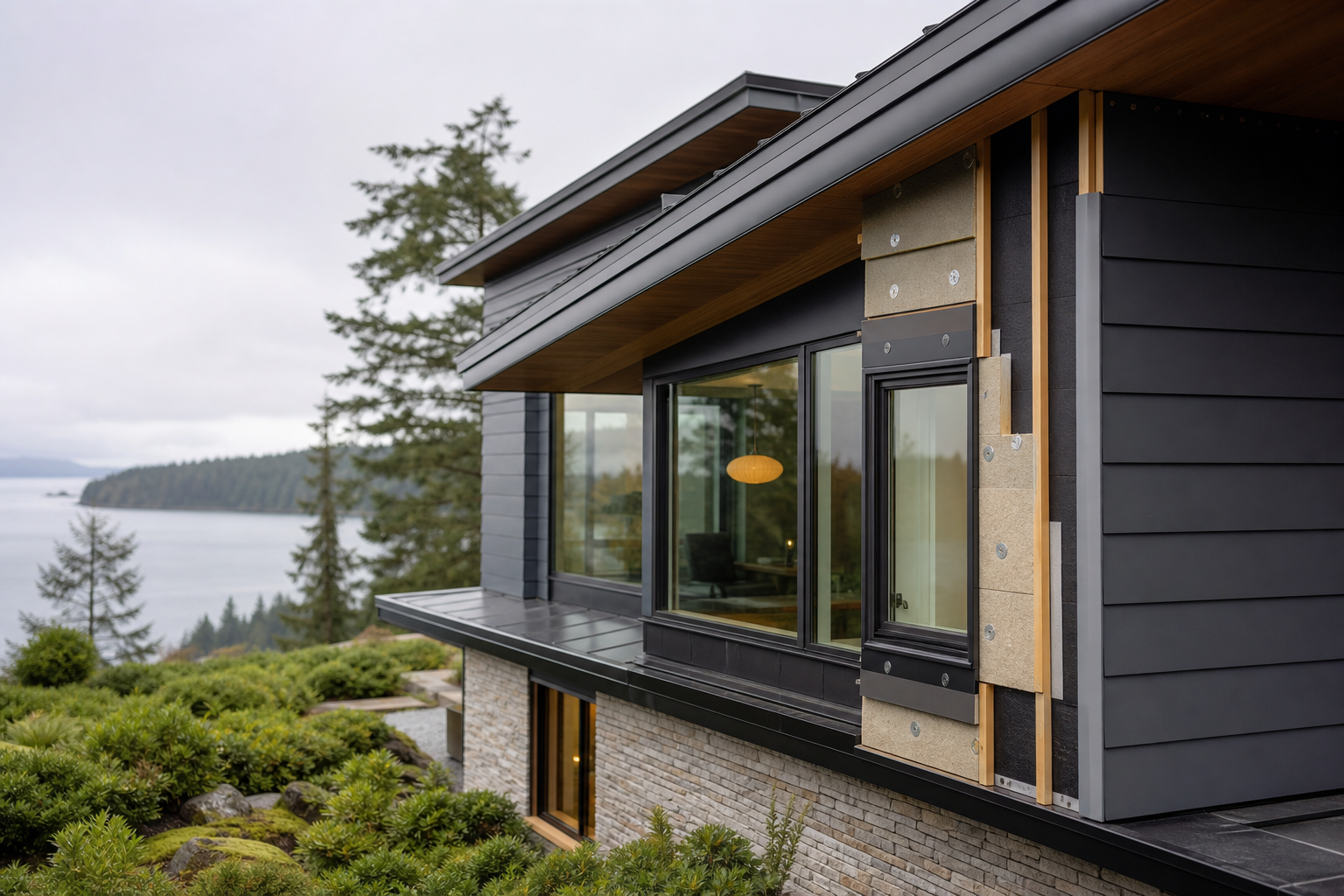
By wrapping the home in a continuous exterior thermal blanket using ROCKWOOL Comfortboard 80, we eliminate thermal bridging and maintain a high whole-wall effective R-value. Comfortboard 80 is highly hydrophobic (water-repellent) yet vapor-permeable, allowing the wall cavity behind it to breathe and dry out.
To achieve maximum longevity, we install two distinct layers of Comfortboard 80 in a meticulously staggered pattern, offsetting every seam so there is no direct path for cold air or wind-driven rain to reach the sheathing.
Once the insulation is in place, we engineer a heavy-duty rainscreen assembly directly on top. Robust 1x4 wood rainscreen strapping is anchored through the rigid insulation and into the structural framing using engineered structural screws. We isolate the top and bottom of this rainscreen cavity with a continuous, heavy-gauge aluminum bug screen to permanently prevent pests from nesting.
Directly at the base of the wall, and above all windows, doors, or ledger boards, we cap these horizontal transitions with custom-fabricated metal flashings. To eliminate a major industry failure point, we mandate that these flashings incorporate mechanical end dams—physically turning the ends of the metal 1 inch in on itself with precision sheet-metal tools. This structural dam stops water from spilling off the edges into the wall cavity, safely forcing moisture outward onto the face of the cladding, while the projected base flashing profile kicks it harmlessly away from the concrete foundation.
When dealing with textured exterior claddings like undulated siding, stucco, or masonry over exterior insulation, mounting fixtures directly onto an irregular finished surface makes it impossible to achieve a reliable seal. Water will inevitably find a path behind the fixture.
To solve this, we install custom penetration blocks (such as PVC or wood blocks) directly on top of our rainscreen strapping before the final cladding is applied.
Because the critical airtightness and waterproof boot seals were already executed directly at the WRB layer around the raw pipe or wire, these blocks serve as the perfect outer mounting platform. They provide a rock-solid, completely flat, and slightly proud surface for your hose bibs, electrical sconces, and mechanical outlets to seat cleanly against. We install a dedicated cap flashing directly on top of the penetration block, integrating it with the rainscreen plane. The cladding is then wrapped neatly around the block, allowing us to apply a pristine, high-performance caulking joint that maintains a perfect, water-tight bond across decades of harsh Vancouver weather cycles.
Windows and doors are massive interruptions in your building envelope. In the construction industry, there is a hard truth we build by: there are windows that leak, and there are windows that will leak. Over a lifespan of decades, factory sealants and gaskets inevitably degrade.
Because water intrusion is inevitable over time, we emphasize crafting a positive 5-degree slope on the structural sill before any waterproofing membrane or tape is applied to the rough opening. By establishing this aggressive slope via a cut stud or a custom-ripped piece of beveled cedar, and protecting it with a durable, seamlessly taped sill pan, any water that eventually bypasses the window unit is gravity-fed harmlessly back to the exterior instead of pooling against the wood framing.
We install low U-value, triple-glaze windows and doors. While traditional insulation is measured in R-value, windows are measured by U-value (the rate of heat transfer, where lower numbers mean better performance). A premium triple-pane unit carries a radically low U-value (often down to 0.8 W/m²K), meaning virtually no heat escapes your home.
We balance this with the Solar Heat Gain Coefficient (SHGC), which measures how much solar radiation passes through the glass. We use a lower SHGC on west-facing glazing to block harsh afternoon rays and prevent summer overheating, while utilizing a higher SHGC on south-facing windows to harvest free, natural passive solar warmth during our dark winter months.
When building custom homes or retreats in higher-elevation areas subject to heavy snow loads, the roof envelope requires just as much strategic planning as the walls to prevent ice damming.
Ice dams occur when unconditioned interior air leaks through the roof assembly. Warm air escapes past the drywall barrier, creating localized "hot spots" on the roof deck that melt the bottom layer of snow sitting directly above it. As that melted water flows down the pitch, it hits the freezing eaves and refreezes instantly, trapping subsequent runoff under the roofing shingles and leading to severe rot.
To permanently defeat this cycle, we introduce a continuous ventilation gap—an upper rainscreen system—directly above the roof insulation layer. By separating the roofing deck from the insulation with structural venting strapping, we ensure a constant sweep of cold outdoor air beneath the roof surface. This air movement completely dissipates any heat buildup, keeping the entire roof surface at a completely uniform, freezing temperature. The snow pack melts naturally and consistently from the ambient outdoor air, eliminating the threat of ice dams entirely.
When a design calls for natural wood trim, combed fascia, or intricate millwork, longevity is won or lost in the micro-details. This is where the gap between average contractors and true craftsmen becomes undeniable:
---
The science of building a durable home is well-documented, but the craftsmanship required to actually build it remains rare. A gorgeous kitchen or a luxury primary ensuite is meaningless if the structural framing behind the walls is quietly rotting because a tradesperson rushed a flashing detail, primed wet lumber, or failed to seal an end-grain penetration.
By marrying the strict targets of modern building science with uncompromising, old-school craftsmanship, we ensure your Vancouver West Side estate remains dry, healthy, and structurally sound for decades to come.
Contact Cloverleaf Builders today to schedule your initial consultation. We will perform a transparent assessment of your home’s existing envelope, outline your structural opportunities, and help you design and craft a home built for maximum climate resilience with minimal maintenance.
Insights and inspiration for Better Living Spaces